A friend of mine applied to more than 70 jobs in three months. Strong experience, solid portfolio, even referrals. Still, almost every application ended the same way… Silence.
At first, he assumed recruiters were overwhelmed. Then he changed one thing on his resume. Suddenly, interview calls started appearing within two weeks.
The strange part? His experience didn’t change. His skills didn’t change. The way AI interpreted his resume did.
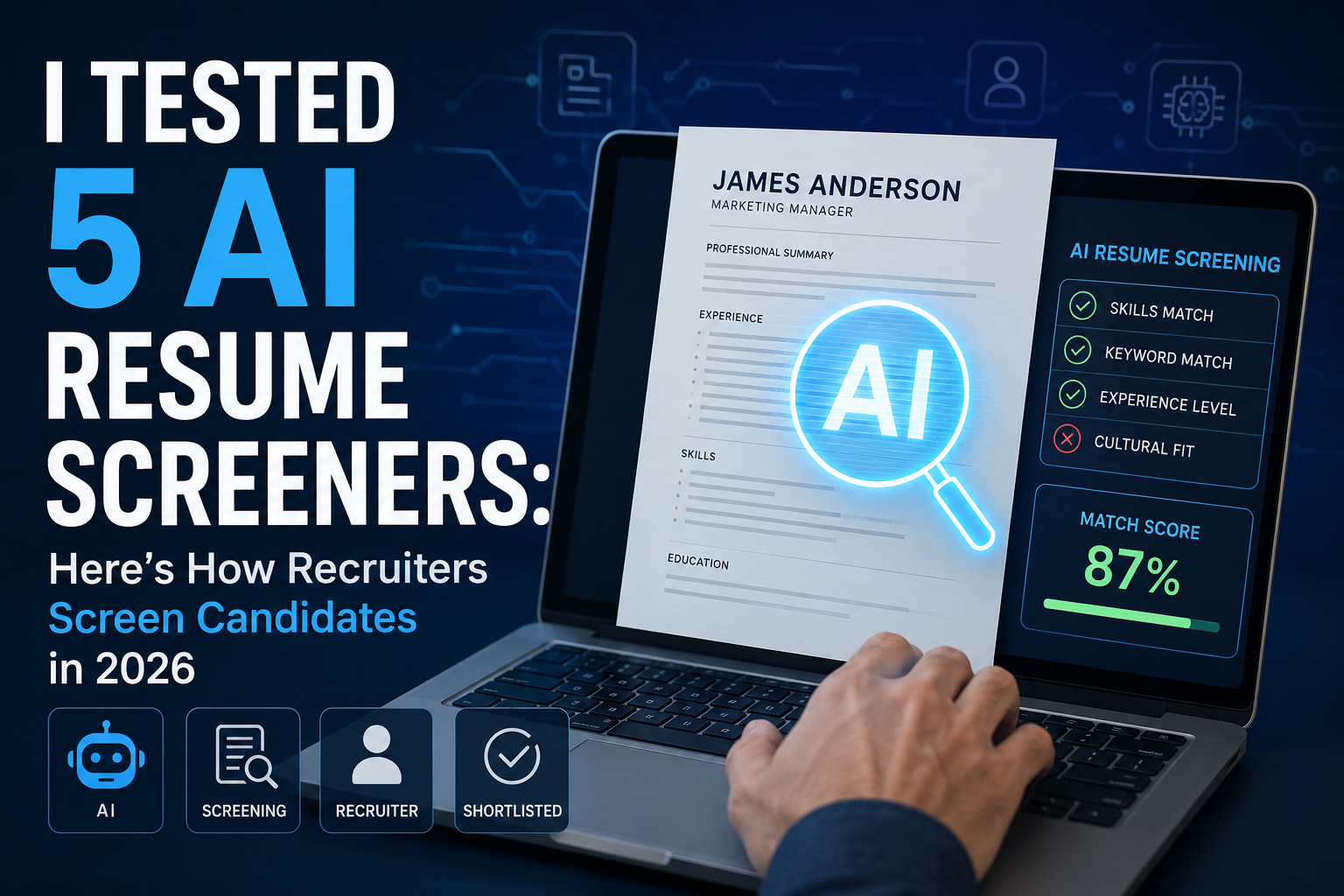
That’s when I decided to test how AI screens resumes in 2026. Not from a recruiter’s perspective, but from the side most candidates never get to see. I uploaded multiple resumes into five popular AI resume screening and ATS resume screening tools to understand what actually happens before a human recruiter opens a file.
What I found was honestly more brutal than expected. Stay hooked!
Why Recruiters Depend on AI Resume Screening Now
Most companies are drowning in smart applications. A single remote job posting can attract thousands of resumes within hours, especially for marketing, tech, design, and customer support roles.
So, recruiters simply cannot read every resume manually anymore. That’s why AI in hiring has moved from being an optional tool to a standard filtering system in 2026.
But here’s the part most candidates misunderstand.
AI tools do not think like humans, whether it is an AI tool for development or hiring. They’re not judging personality, ambition, or even full experience depth. They are matching patterns, keywords, formatting, relevance, and probability scores.
And sometimes, tiny details can completely change the outcome.
The 5 AI Resume Screeners I Tested
To make the comparison more effective, I used three versions of the same resume:
- A clean, optimized version
- A visually designed resume
- A keyword-poor resume with strong experience
Then I tested them across five commonly used AI resume screening platforms and ATS systems.
1. Workday ATS
This was the harshest screener by far.
The designed resume looked visually impressive to humans, but Workday struggled to properly parse sections. Some achievements were ignored completely because of icons and multi-column formatting.
The simpler resume scored much higher despite looking less attractive.
One major takeaway became obvious very quickly: modern ATS resume screening systems still prefer simplicity over creativity.
2. Greenhouse
Greenhouse handled formatting better, but keyword relevance mattered heavily.
The resume with stronger alignment to the job description performed noticeably better, even when the actual experience level was slightly weaker.
That tells you something important about how recruiters use AI screening today. The system prioritizes relevance before quality. If your wording doesn’t align with the role, your experience may never even reach human eyes.
3. Lever
Lever appeared to be more balanced compared to others. It handled readable formatting well and seemed slightly more forgiving with keyword variations.
Still, resumes with vague job titles struggled.
For example:
- Content Specialist performed weaker than
- SEO Content Strategist
Same experience. Different interpretation. That difference alone can impact shortlisting.
4. Rezi AI Resume Scanner
The Rezi AI was fascinating because it openly showed optimization scores.
The tool heavily rewarded:
- measurable achievements
- exact keyword matches
- clean section hierarchy
- readable formatting
What surprised me most was how aggressively it penalized fluff. Phrases like:
- “hardworking professional”
- “team player”
- “go-getter”
… added almost no value.
Meanwhile, specific numbers instantly improved the scoring.
5. Jobscan
Jobscan behaved almost like an AI-powered recruiter assistant. It compared resumes against job descriptions and highlighted missing skill alignment.
This exposed one of the biggest problems candidates face today.
Most resumes are written once and sent everywhere. AI screening systems hate that approach.
The resumes that performed best were customized for each role, even with minor wording adjustments.
So, What Actually Gets Resumes Rejected by AI?
After testing all five AI systems for resume screening, certain patterns became impossible to ignore. Like:
Overdesigned Resume Layouts
Fancy templates may impress humans on LinkedIn, but many ATS systems still struggle with:
- graphics
- text boxes
- icons
- multiple columns
- unusual fonts
In fact, candidates often sacrifice readability for aesthetics without realizing it.
Keyword Mismatch
This is where most applicants fail. Assume you are a digital marketing specialist and ff the job description repeatedly mentions:
- SEO strategy
- Technical SEO
- Content optimization
… and your resume only says digital marketing. AI may treat you as less relevant.
That doesn’t mean stuffing keywords unnaturally. It means speaking the same language as the role.
Generic Experience Descriptions
AI screening tools reward specificity. Compare these two examples: “Managed social media campaigns” vs “Managed Instagram and LinkedIn campaigns that increased engagement by 42% in six months.”
While one sounds generic, the other sounds measurable and relevant.
Interestingly, advanced AI systems notice that difference immediately.
The Biggest Myth About AI in Hiring
A lot of people believe recruiters fully trust AI decisions. But that’s not entirely true.
Recruiters still make final decisions, especially for mid-level and senior roles. But AI controls who gets visibility first. That first filtering stage is where most candidates disappear.
Think of it this way.
AI doesn’t always choose the best candidate. It chooses the most machine-readable candidate. And those are not always the same thing.
So, How Recruiters Use AI Screening in Real Hiring
Most recruiters use AI as a filtering assistant, not a replacement. The process usually looks like this:
- AI scans resumes for relevance
- ATS ranks candidates
- Recruiters review top matches
- Human evaluation begins afterward
The issue is obvious. If your resume never survives step one, your actual talent becomes irrelevant. That may sound unfair, but understanding the system gives candidates a massive advantage.
How to Make Your Resume More AI-Friendly
You don’t need to HACK AI screening systems. You just need to make your resume clearer.
A few adjustments make a huge difference:
- Use clean formatting
- Match important role-specific terminology
- Add measurable achievements
- Avoid vague buzzwords
- Customize resumes slightly for each role
- Keep section headings standard and readable
The goal is not to sound robotic. The goal is to remove friction between your experience and AI interpretation.
Final Thoughts
Testing these AI resume screening tools changed the way I look at hiring completely.
Most candidates assume rejection means lack of skill. In reality, many resumes simply fail communication at the machine level before recruiters even get involved.
That’s why understanding how AI screens resumes is no longer optional for job seekers in 2026. It’s part of the application process itself.
And honestly, the candidates adapting fastest to this shift are already gaining an unfair advantage.


Join the conversation
You must be logged in to post a comment.