
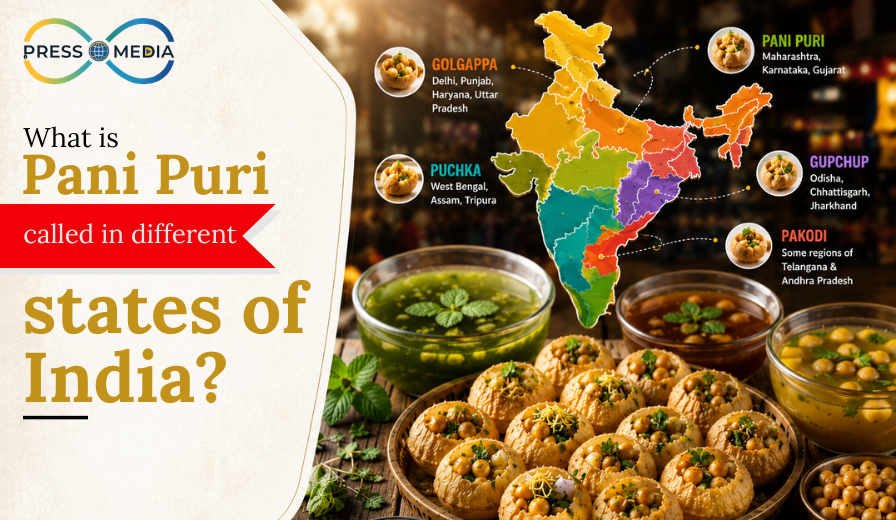
Pani Puri… one snack, ten different names, endless arguments!
Imagine you are traveling across India, craving that familiar burst of spicy water, crispy shell, and mashed filling. You ask for Pani Puri. The vendor smiles and says, “You mean Golgappe?”
A few states later, someone corrects you again, “No, this is Puchka”. Then another city introduces you to “Gupchup”, while someone else swears by “Pakodi”.
One street food turns into a geography lesson.
But the humble pani puri looks familiar everywhere, with a different kick of flavours.
Let’s learn the pani puri’s different names in different states and how they taste a little differently from each other in this Indian street food guide.
Why Does Pani Puri Have Different Names Across India?
Food does not remain unchanged in India.
With changing languages and indigenous ingredients, the food cultures of different regions influence the recipe and create their own version. What began as one loved street food becomes a street snack transformed into multiple regional versions.
This is precisely the reason why looking up Pani Puri in different States of India is more like experiencing culture rather than going through a menu.
And interestingly, people in India often become passionate about defending their local version rather than explaining it.
Pani Puri in Different States of India
Pani Puri– Maharashtra & Gujarat
Signature style: Balanced, slightly sweet, tangy, and layered
Pani puri is one of the most famous in India & trending globally. This is the version that is also most popular among international audiences as well. In Maharashtra, especially Mumbai, you will often find vendors with a “thela gari” selling pani puri. You can experience spicy mint water, sweet tamarind water, and sometimes garlic-flavoured pani.
Golgappe– Delhi, Haryana & Punjab
Signature style: Sharper, tangier, more aggressive spice
North India proudly calls it Golgappa. It is derived from gol (round), and the way it is eaten is whole in one bite. This version usually uses mashed potatoes and chickpeas as filling. The complementary water is also punchier with mint, tamarind, black salt, rested cumin, and green chilli.
Sweetness usually takes a backseat here.
Puchka/Fuchka– West Bengal, Bihar & Jharkhand
Signature style: Tangy, spicy, earthy, less sweet
Puchka or Fuchka deserves its own category because it is not simply another name. It is even prepared differently. The filling usually has mashed potato mixed with black salt, roasted spices, and green chilli. In some areas of West Bengal, you can find shopped onions, peanuts, and coriander as well. It is the Bengali version. So, the water has more tamarind notes with more spices.
Gupchup– Odisha, Hyderabad & Chhattisgarh
Signature style: Light, refreshing, tangy
Gupchup is a common name in every street of Odisha & Chhattisgarh, and some parts of Hyderabad (some cities call it Pani Puri).
Gupchup is served with lighter stuffing because there is more emphasis on flavored water. The taste usually sits somewhere between North India’s tanginess and East India’s spicy-forward style.
Phulki– Madhya Pradesh
Signature style: Lighter seasoning, cleaner flavour profile
Phulki generally has a lighter-style pani puri with emphasis on the crispy shell and seasoned water rather than heavy fillings. You can find this in some places in Madhya Pradesh. The spiced water is a blend of fresh mint leaves, coriander, green chillies, and lemon juice. It gives the water a sharp, zesty kick.
Paani ke Batashe/Padaka– Uttar Pradesh
Signature style: Bold, spicy water with simpler fillings
Paani ke Batashe is a strong regional identity in Uttar Pradesh. It is commonly heard across parts of UP, while Padaka is more localized. This version has light filling with a strong tamarind, black salt, mint, and spicy flavored water.
Golgappa vs Pani Puri vs Puchka: Are They Actually Different?
The debate on Puchka vs Golgappa or Golgappa vs Pani Puri is quite old. But are they actually different?
Not really. Not that they are more like cousins.
| Version | Main Region | Typical Filling | Flavor Style |
| Pani Puri | West India | Potato, ragda | Balanced & slightly sweet |
| Golgappa | North India | Potato, chickpeas | Tangy & spicy |
| Puchka | East India | Spiced mashed potato | Bold & intense |
| Gupchup | Odisha/Chhattisgarh | Regional mix | Refreshing & tangy |
| Patashi | Rajasthan | Potato-based | Spicy |
While the shell may look similar, the personality of the filling and water changes with every region.
Why International Food Lovers Are Becoming Obsessed with Pani Puri
Global audiences discover Indian foods through butter chicken or biryani.
But street food tells a different story. Amongst them, the most popular street food names in India is Pani Puri. The crunchy shell, spice, surprising tangy water, and interaction with the single bite challenge are the reasons for creating buzz.
One bite… and people either fall in love or immediately reach for water.
Final Bite
Whether you call it Pani Puri, Golgappa, Puchka, Gupchup, Patashi, or Batashe… India can turn one snack into dozens of local identities. And that’s exactly why exploring the Indian street food guide is never boring.
As you have unveiled the name of Pani Puri in different states of India, skip the debate over which one is original & try them all.
Because sometimes the best way to understand India is one crunchy bite at a time.
FAQs
What is Pani Puri called in different states of India?
Pani Puri across India goes by various names according to the region. Pani Puri is the name of this delicacy in Maharashtra and Gujarat. In Delhi, Haryana, and Punjab, it is known as Golgappa. In West Bengal, Bihar, and Jharkhand, it is known as Puchka or Fuchka. Gupchup is its name in Odisha and Chhattisgarh, while some parts of Uttar Pradesh call it Pani Ke Batashe.
Why is Pani Puri known by different names across India?
The food culture in India differs according to the region. Street foods like Pani Puri are customized to fit into their language, cuisine, and eating habits. In due time, the snack was customized to the taste of each region and was given a regional name.
What is the difference between Puchka, Golgappa, and Pani Puri?
The major difference lies in the filling and taste. While Puchka is generally spicy with a strong taste of tamarind and mashed potato filling, golgappa is made using chickpea and tangy water. On the other hand, pani puri comprises potato, ragda, and sweet chutney.
Which state is believed to be the origin of Pani Puri?
The definite origin of this street food is yet not known, but an accepted theory regarding its origin is that it came from the ancient Magadha area, which is presently found in the state of Bihar.
Why does Puchka taste different from Pani Puri?
The Puchka is generally made using a very spiced version of potatoes and tamarind sauce without any sweetness at all. The traditional Pani Puri has a well-balanced sweet, sour, and spicy flavor.
What is Pani Puri called in West Bengal?
Pani Puri in West Bengal is popularly known as Puchka/Fuchka. It is distinguished by its strong taste, crunchy cover, and spiced mashed potatoes.
What is Pani Puri called in Delhi and North India?
In Delhi as well as other parts of North India, it is called Golgappa. This type is famous for its crispy puris, chickpea filling, and sour pani.
Which Indian state serves the spiciest version of Pani Puri?
There is no official ranking. But Puchka in West Bengal is often considered among the spiciest because of its strong chilli, spice-heavy, and tamarind filling.
Are the ingredients of Pani Puri the same in every state?
Absolutely not! Though the crispy puri still remains popular, the filling and flavored water are not similar throughout. Potato, chickpea, ragda, tamarind, mint, and various spices are used in different regions.
Which is more popular in India: Pani Puri, Golgappa, or Puchka?
They are essentially regional versions of the same street food, so popularity depends on geography. Nationally, Pani Puri is the most widely recognized name, while Golgappa and Puchka dominate strongly in their respective regions.
Join the conversation
You must be logged in to post a comment.