Think of a doctor at a rural clinic who needs to understand complicated medical data in the absence of any specialist help. Or an upcoming healthcare business struggling to develop an AI-powered system while ensuring compliance with medical regulation standards. This is no far-fetched scenario but the reality.
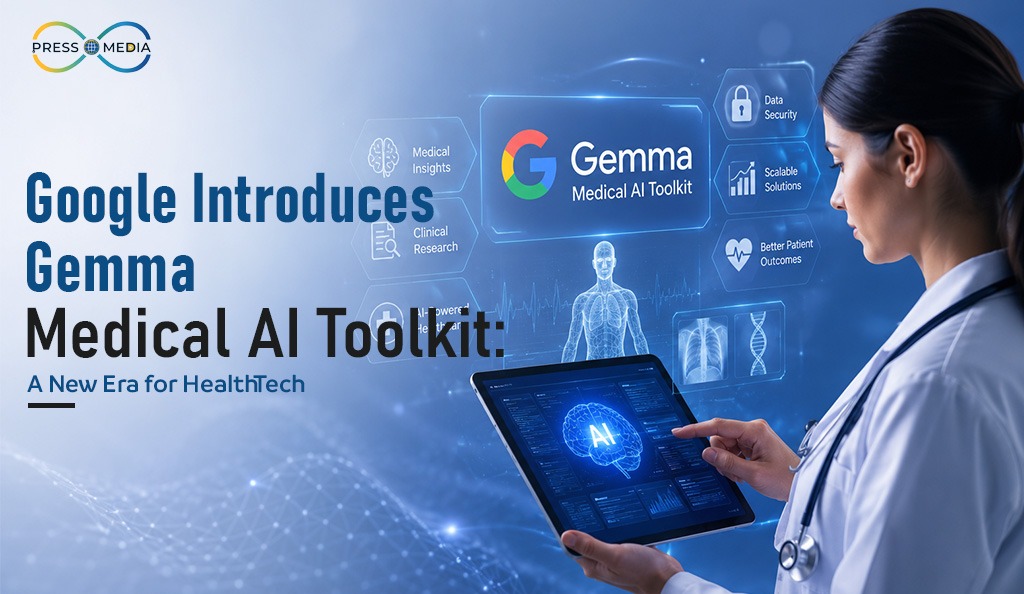
That’s exactly where Google Gemma Medical AI Toolkit entered as a solution. Instead of developing yet another chatbot for the health care industry, Google offers developers a dedicated toolkit to build safe, fast medical AI apps.
Learn how this advanced toolkit can significantly lower the barrier to building intelligent healthcare solutions while accelerating innovation across the industry.
What Is the Google Gemma Medical AI Toolkit?
The Google Gemma Medical AI Toolkit is Google’s new healthcare-focused AI toolkit based on their Gemma series of open models. Instead of designing an all-in-one AI assistant, the kit helps software developers design medical applications that better comprehend healthcare terminology, clinical documentation, radiological image processing, and other patient data.
Unlike general AI models, medical AI needs domain knowledge, increased precision, improved safety measures, and enhanced transparency. This kit was created with such concerns in mind.
The main aim of this kit is to make it easier for developers to create Medical AI Software that assists rather than replaces healthcare professionals.
Why Google’s Move Matters for the Healthcare Industry
Healthcare is always one of the most challenging industries for artificial intelligence.
While a small mistake in content generation might be harmless for marketing chatbots. However, the same mistake in healthcare applications could affect the overall patient care.
That’s why healthcare AI demands far more rigorous standards than most of the other industries.
Google Gemma Medical AI Toolkit addresses this challenge by allowing developers access to models and resources specifically designed for medical use cases. This can be a faster path to building reliable AI healthcare solutions without starting from scratch.
How the Google Gemma Medical AI Toolkit Works
The core essence of the toolkit is that it allows developers to tailor the pre-trained medical AI abilities for various situations in healthcare. Here’s how it actually works:
Medical Language Understanding
Medical specialists use highly specialized terminology. This toolkit allows the machine learning model to comprehend clinical notes, diagnoses, prescriptions, and all other documentation related to health care.
This significantly improves the quality of AI responses compared to generic language models.
Medical Image Interpretation Support
Among some of the more interesting applications is medical imaging.
Developers can build systems to help radiologists by identifying patterns from X-rays, CT scans, MRIs, or even pathology images. Of course, the ultimate diagnosis is always made by the experts in the field, but AI can make the process easier for them.
Clinical Documentation Assistance
Physicians spend a large part of their time on note-taking instead of taking care of the patients.
The Gemma Medical AI toolkit can be very useful for document automation, summarizing patients’ histories, arranging documents, and making work more efficient.
One of the fastest-growing areas in terms of AI in Healthcare is definitely this one.
What This Means for Healthcare Software Development
The introduction of Google’s toolkit will definitely change the HealthTech Software Development industry in the upcoming years.
A few years ago, it was impossible to develop medical software without large amounts of data, costly infrastructure, and very skilled AI developers to develop medical applications. This often limits innovation for large enterprises.
Now, it is much easier for startups, digital health companies, hospitals, and even healthcare software development companies to move their ideas faster using Google’s infrastructure.
But this does not stop the need for medical expertise or healthcare regulatory compliance. Rather, it can dramatically reduce the technical complexity involved in building intelligent healthcare platforms.
Real-World Applications Across Healthcare
Google’s MedGemma and the Medical AI Toolkit are rapidly transforming global healthcare by standardizing unstructured records. The following healthcare sectors are actively deploying these models:
- Medical imaging & diagnostic support (3D scan processing & digital pathology)
- Clinical reasoning & text comprehension (automate reports & medical document analysis)
- Therapeutics & patient care (interviewing & summarizing physician progress)
What Are the Benefits for Developers and HealthTech Companies
Speed is probably one of the major strengths for developers.
As developers no longer have to spend months building models that understand medical terminology, they can concentrate on real-world medical issues.
The Google Gemma and Medical AI toolkit allows developers to:
- Launch healthcare AI products faster
- Reduce development costs
- Improve model reliability
- Build scalable medical applications
- Customize AI for specialized healthcare workflows
In fact, AI startups are experiencing the most competitive advantage in the digital health market.
Any Challenges with the Toolkit?
Medical AI is typically a decision-support technology. It can hardly replace the need for healthcare professionals.
Even though there might not be any significant challenges with the Gemma and Medical Data Toolkit, there are still some considerations that require special attention:
➜ Gemma and MedGemma are foundational developer tools, not plug-and-play applications. They require extensive prompt engineering.
➜ Some studies claim that the AI has been shown to downplay women’s physical and mental health issues.
➜ Like all other LLMs, it is also susceptible to fabricated information and to misinterpreting complex clinical contexts.
➜ Even though MedGemma has an open-source nature for local execution and better privacy, the multimodal models require significant computational resources.
Final Thoughts
Google Gemma Medical AI Toolkit indicates an industry-wide movement in healthcare technology from exploration to implementation of AI systems.
In light of this development, any organization involved in Healthcare Software Development should focus on the time it will take to produce safe, ethical, and useful software rather than the inclusion of AI in healthcare.
So, if your organization is planning to develop AI-powered healthcare applications, now is the right time to explore how modern AI frameworks can be integrated. Don’t forget to share your experience with us!
Frequently Asked Questions (FAQs)
What is Google’s Gemma Medical AI Toolkit?
Gemma Medical AI Toolkit by Google is an assembly of AI models, tools, and resources that are used for developing intelligent health care applications. This toolkit can be used for the purpose of clinical documentation, medical imaging analysis, and health care data processing.
How does the Gemma Medical AI Toolkit help healthcare software developers?
The toolkit provides pre-built AI models and development tools that minimize the time and effort required for developing health care apps. It saves developers’ time because they have to concentrate only on making reliable features rather than training AI models for medical purposes.
What are the key features of Google’s medical AI toolkit?
Key capabilities include language understanding with a healthcare context, clinical documentation, AI-based image analytics, open models that can be customized, and development tools for developing secure and scalable healthcare applications.
Which healthcare applications can be built using Gemma?
Programmers are able to create AI-based clinical assistants, medical documenters, diagnostic assistance, telemedicine solutions, patient engagement, medical research, and healthcare data analytics through the Gemma Medical AI Toolkit.
Can startups use Google’s Gemma Medical AI Toolkit for healthcare projects?
Yes. This tool can be used by startups, researchers, and even traditional health care institutions. It allows small businesses to create novel AI applications in the health care sector without spending too many resources on training the AI from scratch.
How does AI improve healthcare software development?
AI improves healthcare software development by automating routine procedures, analyzing data, aiding in clinical decision-making, documenting, and personalizing patient experiences. These factors contribute to the development of better and more efficient healthcare applications.
Is Google’s Gemma Medical AI Toolkit open source?
The AI Gemma model set is licensed in an open-source manner, enabling developers to design applications responsibly. Nevertheless, it is important for users to look into the licensing policies of Google regarding this model set when working on any healthcare application.
What are the benefits of using AI in medical software development?
AI assists in increasing operational efficiency, minimizing administrative burden, speeding up data analysis, improving diagnostics, and providing intelligent health care applications. In addition, it gives software engineers the opportunity to develop scalable and patient-oriented software.
How secure is patient data when using AI-powered healthcare applications?
The security of patient data will depend on the design and deployment of the application. The following are some of the best ways of securing this data: use of data encryption, access controls, data anonymization, and compliance with the healthcare regulatory requirements like HIPAA or GDPR.
How can businesses integrate Google’s Gemma Medical AI Toolkit into existing healthcare systems?
Companies can deploy the tool through APIs, cloud computing, or software development. The successful deployment usually means linking the abilities of AI to either EHRs, hospital management systems, or telehealth solutions while maintaining security and compliance.



Join the conversation
You must be logged in to post a comment.