Think of two equally qualified professionals, undertaking similar projects.
While one person would be busy the whole morning gathering information, creating documentation, verifying data, preparing drafts, and performing various routine operations manually, the other would let AI take care of most of these tasks and spend time assessing the results, resolving any complications, making decisions, and improving the outcome.
Both can produce high-quality output.
But one can do it several hours quicker.
This difference is already becoming one of the biggest changes in modern work.
And the discussion about AI usually begins with a wrong question: “Is AI going to take my job?”
Let’s find out!
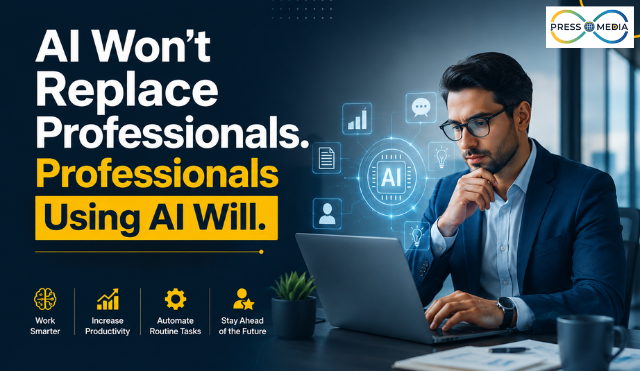
AI Won’t Replace Professionals, But It Will Change Professional Work
AI taking over human professionals is an over-simplistic perspective.
AI is capable of writing code, analysing information, producing drafts, writing summaries, generating images, streamlining processes and handling huge chunks of data. However, producing output doesn’t necessarily mean understanding the problem at hand.
A business will always need someone who understands the customer, evaluates risks, challenges assumptions and decides whether an AI-generated answer actually makes sense.
That’s why the future is not necessarily humans versus AI.
It is increasingly becoming professionals with AI versus professionals without it.
What AI-Powered Workflows Are Actually Changing
The use of AI in the workplace goes beyond just using a chatbot to draft an email.
What really matters is how it impacts the workflow.
Let us take the example of a software development team.
Before, the developer could be spending a lot of time researching the documentation, writing redundant code, writing test cases, and troubleshooting basic errors. AI technology now helps with many such activities, enabling the developer to focus more on architecture, security, performance, and the business need itself.
It happens elsewhere too.
A marketer can leverage AI to analyze campaign data and create some initial content ideas. A salesperson can automate parts of their lead research process. An operations manager can leverage AI to find patterns in their huge dataset instead of sifting through spreadsheets.
The professional has not vanished.
The nature of the job has changed.
How AI Productivity Tools Are Becoming a Professional Advantage
Being able to work in Microsoft Excel used to be an advantage.
But then there was cloud collaboration, automation software, and specific business applications.
Now, AI productivity software is joining the discussion, though with one big difference.
Using AI Is Not the Same as Knowing How to Use AI
Simply opening an AI tool and requesting that it “do the work” is not an AI strategy.
Professionals still need to understand how to frame a request, provide the necessary context, and check the outcome and whether it is acceptable.
In other words, an AI tool can deliver a technically excellent piece of code that does not match the system’s architecture. An AI can create a sophisticated business suggestion using inaccurate data. It can summarize a document while omitting the most important point.
Ultimately, the professional’s evaluation of the process is crucial.
AI can speed up the process. It cannot be responsible for the decision made.
Why Continuous Learning Is the Real Competitive Advantage in This AI Era
Learning is the one true competitive advantage in an era of artificial intelligence because anything static will soon be outmoded. While artificial intelligence allows everyone equal access to standardized data and applications, the only real advantage is the ability to learn faster than the competition.
Why AI Makes Learning Essentials
- Rapid Obsolescence: With advancements in AI technologies occurring within weeks, the lifespan of a static set of technical skills becomes increasingly short-lived.
- Commoditized Tech: Since everyone has access to AI technologies through licensing or otherwise, the technology does not constitute an advantage anymore; learning how to utilize it fast is what counts.
- Context and Judgment: While AI technologies provide information and outputs, humans need to think critically about how they apply to real-life situations.
This is why AI wont replace jobs in the simplistic way people often imagine.
So, What Should Professionals Start Doing Now?
As you have understood, AI Won’t Replace Professionals does not mean you must become an expert on AI overnight.
Begin by examining your own workflow.
Consider those tasks that you do regularly each week. What is it that takes up your time yet requires relatively low amounts of judgment?
The professionals who keep learning, questioning, and experimenting will gain an edge over those who stick to the ways of doing things that were good enough five years ago.
It is time for you to adapt to the new AI technologies and automate your workflow!
Frequently Asked Questions (FAQs)
Will AI replace professionals in the future?
AI is more likely to change professions rather than replace them. Repetitive tasks can be automated, but humans will always retain skills that make them valuable, such as creativity and judgment.
How can professionals use AI to improve productivity?
Through AI, professionals can automate their routine activities, do research, create drafts, analyze information, and optimize their workflow process. This gives professionals more time to focus on activities requiring human intelligence and skills.
What tasks can AI automate in the workplace?
Tasks like data analysis, information summarization, writing, processing of information, coding and workflow automation can be accomplished using AI. The extent of automation varies with the task, industry and the degree of supervision by humans.
Why is human expertise still important when using AI?
Output of AI systems may have flaws and can be biased. Human experts are required to judge the output and make a call on the basis of business understanding.
How can professionals develop AI skills for the future?
First of all, learn the AI tools applicable in your field, try out some applications and learn how to assess the AI output. The combination of AI literacy with continuous learning and strong human competences like critical thinking and creativity will become increasingly vital.


Join the conversation
You must be logged in to post a comment.