
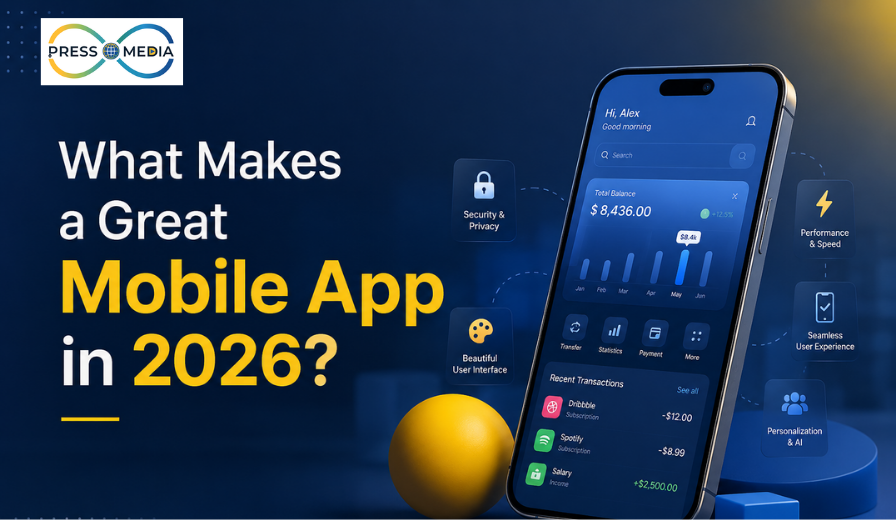
You may design & develop a mobile application, spending months on it, providing it with a beautiful interface and many useful features. But still, users may disappear after the very first use.
The reason is that users do not evaluate an application in terms of the technologies it uses. Instead, they value how efficiently the application solves their problem and how trustworthy it is.
So, what actually separates a great mobile app people actually download &continue using?
Let’s take a look at the mobile app development trends 2026 is bringing to the forefront!
What Does a Great Mobile App Look Like in 2026?
A good app is not just an effective app anymore.
The application should seem almost easy to operate. It means that users have to launch the app, get instructions on what to do next, perform their actions and exit without struggling with the interface.
Good apps also predict users’ needs and requirements. They employ smart analytics, provide a personalized experience for customers, and apply AI.
For instance, a banking app notices an unusual transaction and immediately explains it. Or consider a shopping app that understands what the target users are actually looking for instead of making you browse through dozens of categories.
7 Mobile App Development Trends 2026 Businesses Should Watch
1. AI Is Moving From a Feature to the Experience
AI-based mobile applications are moving far away from the old-fashioned chatbot placed inside a support section.
In 2026, AI can affect the overall behavior of an application.
The productivity app can highlight some facts and suggest the next step to take. The fitness app can modify suggestions according to the user’s behavior. The e-commerce app can enhance product search based on understanding the user’s intention instead of just working with keywords.
What’s fascinating is that users will probably never know where AI is applied.
It’s good.
The best AI stays hidden. It eliminates repetitive steps instead of shouting about being AI-powered workflow.
2. Personalization Is Becoming More Contextual
Personalization meant something straightforward in the past: “Hi, Priya. Products you will probably like.”
That is no longer the case.
Advanced apps today can look at behavior, preferences, geographical context, interaction history, and many other factors to create a more relevant experience for the user.
However, there is a very thin line in all this.
Users will be happy with personalized services if it looks helpful. But if they feel like the application knows way too much about them, all trust goes out the window.
3. Mobile App UX Is Becoming a Competitive Advantage
Two applications can perform the same function and give entirely different outputs.
How is that?
Because of user experience.
The ability to onboard users quickly, have an easily navigable interface, be readable, and provide interaction without any frustration will directly influence whether users stick with the application or not.
One of the best mobile app development practices in 2026 is not to design your product based on what you want to show to the user but rather on what the user needs to do.
Every extra click poses a question:
Do I need it?
4. Security and Privacy Are Part of the Product Experience
Encryption and authentication standards may not be understood by users; however, asking them to provide too much information will definitely make them realize this issue.
Thus, the security and privacy of mobile applications are not only new technical demands; they are becoming part of the overall application experience.
Authentication and permissions, protection of sensitive information through encryption, secure API, and privacy policies must be considered in the architectural design of the application – not in its development.
A gorgeous application could destroy years of customer trust within minutes due to a security issue.
5. Voice and Natural Interaction Will Become More Useful
Typing may not be the most efficient form of communication.
Voice commands and conversational UI become more relevant as people try to search and navigate through apps or execute actions rapidly.
Think of saying to a business app, “Show me sales from West Bengal this month.”
This isn’t the case of technology being used for the sake of technology.
It is making one step less between the user and the information needed.
6. Cross-Platform Development Will Focus More on Consistency
Firms are looking for apps that work on both Android and iOS, without being entirely separate products.
While cross-platform development may be useful for decreasing effort and speeding up time to market, this is not the whole story.
The main difficulty lies in keeping performance, responsiveness, and appropriate interactions on all platforms.
There needs to be a balance between development efficiency and user expectations on specific platforms.
7. Apps Will Be Designed for Continuous Evolution
The old way of thinking was:
Build → Deploy → Support.
The new formula is:
Build → Learn → Optimize → Iterate.
Users evolve. Hardware evolves. The power of AI evolves. Competition evolves.
Consequently, a successful mobile app should have an architecture capable of evolution, without having to rebuild everything from scratch every time the company rolls out new capabilities.
This implies that modularity, scalability of the backend systems, analytics, and product iterations are just as important as the features initially introduced.
The Successful Mobile App Features That Actually Matter
One is tempted to create a long list of features before launch.
More dashboards. More filters. More integrations. More buttons.
However, feature count does not make a great product.
A number of the most successful mobile application features tend to be rather simple: quick search, easy onboarding, intelligent notifications, customized suggestions, effortless payments, offline capability, and smooth navigation.
What matters is not
“What can we add?”
but
“What can we eliminate?”
This difference may take many months off development.
AI-Powered Mobile Apps: Where Businesses Should Be Careful
AI can make an application dramatically more useful—but adding AI simply because competitors are doing it is a mistake.
Suppose a food delivery app already lets users search restaurants efficiently. Adding a chatbot that merely repeats search results doesn’t create much value.
Now imagine the user says:
“I need dinner for four, vegetarian, under ₹1,200, and it should arrive within 40 minutes.”
An AI system that understands that request, considers available restaurants and presents useful options is solving a genuine problem.
That’s the difference between AI as decoration and AI as product capability.
Before integrating AI, businesses should identify repetitive decisions, information-heavy workflows and areas where users regularly need assistance. Those are usually better opportunities than simply adding an AI chatbot to the interface.
Mobile App Development Best Practices for 2026
Design for the First Five Minutes
The first few minutes can determine whether an application earns a second session.
Don’t force users through a long registration process before showing value. Let them understand what the application does, reach a meaningful outcome quickly, and ask for additional information only when it becomes necessary.
Build Performance Into the Architecture
Even a beautifully designed app that takes too much time to respond is technically flawed.
Performance needs to be assessed based on API response time, image processing, database queries, caching, app size, and network speed, considering the unpredictable connectivity faced by many users across India.
Use Analytics to Understand Behaviour
Analytics should not be created solely to produce monthly reports.
Check for points of dropout, repeat actions, failed transactions, and abandoned onboarding stages or infrequently used features. They will indicate what part of your product requires your attention.
Test With Real Users
Internal teams understand the product inside out.
A function that is so obvious to a software engineer may confuse another user who sees it for the first time. Usability testing can bring up such issues before the product faces them in the market.
The Future of Mobile Apps Is Less About Screens
The mobile app development trends of 2026 are not necessarily going to be drastically different from the current set of apps.
They will still have many of the same interface elements that we’ve come to recognize and expect: screens, menus, buttons and dashboards.
What will be different is what goes on behind the scenes.
An application developed in 2026 must not only be engineered to last for the next couple of years but also in such a way that it can withstand changes in technology and business needs.
Frequently Asked Questions (FAQs)
How important is AI in modern mobile apps?
The significance of AI in mobile applications is increasing day by day due to its capability to automate certain functions, personalization, recommendations, and natural language processing. What really matters is to integrate AI when it helps in solving a genuine user issue.
What makes a mobile app user-friendly in 2026?
An application that is friendly to use must be fast, intuitive, accessible, and navigable. Good interfaces, smooth interaction, and personalization, among others, help improve the mobile app user experience.
How can I improve mobile app security and data privacy?
Ensure that your app is secure from the very beginning of its design process by incorporating authentication, secure data storage and data encryption, and secure APIs. You could adopt widely recognized security standards such as the OWASP Mobile Application Security Verification Standard (MASVS).
What are the top mobile app development trends to follow in 2026?
Some of the trends include the use of artificial intelligence for developing mobile apps, contextual personalization, conversational interfaces, increased emphasis on privacy and security, cross-platform development, and enhanced app performance. The most dominant trend among all these, however, is the use of technology to ease user effort instead of complicating it.

Join the conversation
You must be logged in to post a comment.